Key evaluation information, including WFSRI, evaluation framework, methodology and results, now presented in a more structured format
SEC Analysis & Newsroom reorganized to strengthen professional analysis of ESG, responsible management, corporations and public institutions
First SEC ESG·WFSRI Evaluation of Corporations and Public Institutions underway, with final results scheduled for February 2027
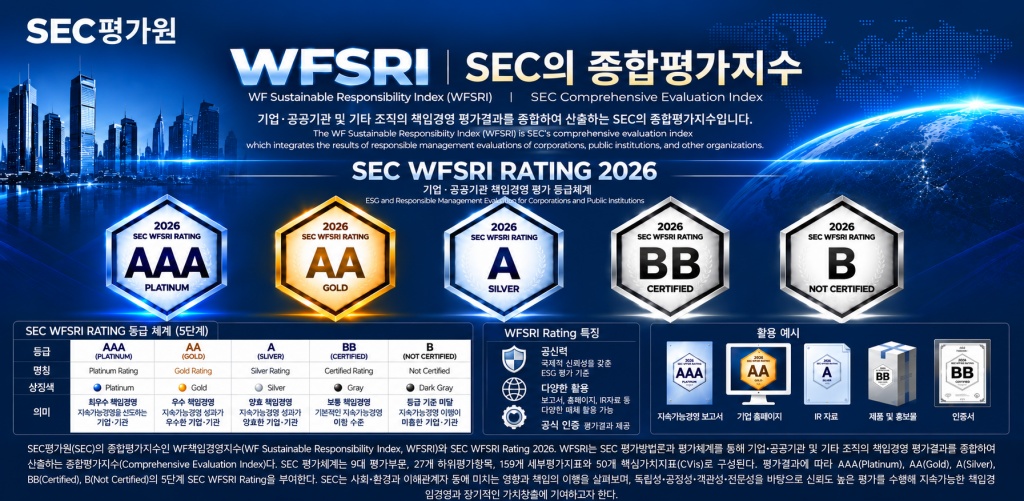
The WF Sustainable Responsibility Index (WFSRI), SEC’s Comprehensive Evaluation Index, and the SEC WFSRI Rating 2026. WFSRI is SEC’s Comprehensive Evaluation Index, calculated by comprehensively reflecting the responsible management evaluation results of corporations, public institutions and other organizations derived through the SEC Evaluation Methodology and SEC Evaluation Framework. The SEC Evaluation Framework consists of 9 evaluation areas, 27 subcategories, 159 detailed evaluation indicators and 50 Core Value Indicators (CVIs). Based on the evaluation results, organizations are assigned one of five SEC WFSRI Rating levels: AAA (Platinum), AA (Gold), A (Silver), BB (Certified) or B (Not Certified). SEC examines organizations’ impacts on society, the environment and stakeholders, as well as how they fulfill their corresponding responsibilities. Based on independence, fairness, objectivity and professionalism, SEC conducts credible evaluations to contribute to sustainable responsible management and long-term value creation.
SEC (Sustainable Enterprise Evaluation Commission), a specialized evaluation institution for corporations and public institutions operated by SEC Co., Ltd. (CEO and Chairman: LEE, SAN-HA), has completed a comprehensive overhaul of its official website (secevaluation.com). The redesign reorganizes key content covering WFSRI, the evaluation framework, evaluation methodology, ratings and results, while also restructuring the SEC Analysis & Newsroom to improve access to evaluation-related information and strengthen professional analysis.
The overhaul reflects a longstanding question about how corporations and public institutions should be viewed and evaluated.
Why Evaluation of Corporations and Public Institutions Matters
Corporate activities affect not only shareholders and investors but also consumers, employees, business partners, local communities and markets. The operations and decision-making of public institutions likewise affect people’s lives and public services, requiring accountability commensurate with their public responsibilities and the public resources invested in them.
Since 2017, the WORLD FEDERATION OF POWER LEADERS, WFPL has continuously raised a fundamental question: Is it sufficient to assess corporations and public institutions solely on the basis of business performance or operational results?
Alongside examining what an organization has achieved, it is also necessary to consider how its activities affect society and the environment, stakeholders and communities, and how the organization fulfills the responsibilities corresponding to those impacts.
This question has become increasingly important as corporations and public institutions face rapidly changing conditions, including climate and environmental change, technological innovation, supply chain restructuring and shifts in industrial structures.
Research Began in 2017 and Developed into WFSRI
Based on this recognition, WFPL began research and development in January 2017 to establish a comprehensive approach to evaluating the responsible management of corporations, public institutions and other organizations.
The research focused not only on an organization’s current performance but also on how to objectively and systematically evaluate the impacts of its activities and the fulfillment of responsibilities corresponding to those impacts.
Research and development of evaluation standards, indicators and methodology continued for approximately 10 years, culminating in the establishment of the WF Sustainable Responsibility Index (WFSRI) on November 1, 2025.
WFSRI: SEC’s Comprehensive Evaluation Index for Responsible Management
WFSRI is SEC’s Comprehensive Evaluation Index, calculated by comprehensively reflecting the results of responsible management evaluations of corporations, public institutions and other organizations derived through the SEC Evaluation Methodology and SEC Evaluation Framework.
WFSRI does not refer to the SEC Evaluation Framework itself, nor is it a simple aggregation of individual evaluation indicators. It comprehensively reflects the evaluation results derived through SEC’s methodology and framework to represent an organization’s level of responsible management.
The current SEC Evaluation Framework consists of 9 evaluation areas, 27 subcategories and 159 detailed evaluation indicators. Among them, 50 Core Value Indicators (CVIs) serve as key indicators designed to reflect the core values and major elements of responsible management.
Website Overhaul Improves Access to Key Evaluation Information
As part of the overhaul, SEC has reorganized the website’s information architecture so that users can more easily access and understand SEC’s key evaluation information.
The main page now features six core areas: WFSRI, SEC WFSRI Rating, SEC Evaluation Framework, SEC Evaluation Methodology, Evaluation Results and Certification.
Major sections covering SEC, evaluation information and information disclosure have also been reorganized according to their respective functions. Users can access information by area, from fundamental evaluation concepts, methodology and framework to ratings, results and certification.
SEC Preparing Trademark Application to Strengthen Brand Protection
SEC is preparing to file a trademark application for “SEC평가원” with the Korean Intellectual Property Office as part of its efforts to systematically protect its institutional name and brand.
Alongside the comprehensive website overhaul, SEC is refining its institutional naming and brand system. Through the planned trademark application, SEC aims to further clarify its brand identity as a specialized evaluation institution for corporations and public institutions and strengthen the foundation for intellectual property protection.
SEC Analysis & Newsroom Reorganized to Strengthen Professional Analysis and Information Functions
SEC has reorganized the SEC Analysis & Newsroom to strengthen its professional analysis and official information functions.
SEC Analysis consists of six areas: ESG & Responsible Management, Corporate Analysis, Public Institution Analysis, Industry & Market Analysis, Data & Statistics, and SEC Research.
This structure reflects the view that properly understanding corporations and public institutions requires examining not only the activities of individual organizations but also changes in the broader management environment, including industries and markets, policies and institutions, technology, supply chains, climate and environmental issues, consumption and demand.
SEC plans to research and analyze major domestic and international developments and structural trends across these areas and provide relevant data and research materials. The SEC Newsroom provides official information, including major SEC news and press releases.
First SEC ESG·WFSRI Evaluation of Corporations and Public Institutions Underway
SEC is currently conducting the First SEC ESG·WFSRI Evaluation of Corporations and Public Institutions, focusing on companies listed on the KOSPI and KOSDAQ markets and public institutions.
For corporations, the evaluation considers their impact on a wide range of stakeholders and markets, including shareholders, investors, consumers, employees and business partners. For public institutions, it considers their public nature, impact on people’s lives and public services, and the public resources invested in them. Evaluation targets are selected on the basis of public interest, public responsibility and social necessity.
Evaluation data is being collected from January 1 through November 30, 2026. Final evaluation results are scheduled to be announced in February 2027 following established procedures, including Factual Review, Appeal, comprehensive review and deliberation by the Evaluation Committee.
LEE, CHEE-SOO, Chair of the Evaluation Committee: “Evaluation Should Go Beyond Assigning Ratings”
LEE, CHEE-SOO, Chair of the SEC Evaluation Committee, said, “Evaluation should not stop at assigning a score or rating to corporations and public institutions. What matters is examining, through objective data and consistent standards, whether they properly recognize the impact of their activities on society and how they fulfill the responsibilities corresponding to that impact.”
“For evaluation results to earn public trust, the evaluation institution itself must remain independent from interested parties and external influence, while fairness and objectivity must be maintained throughout the entire evaluation process,” LEE said. “SEC will apply these principles rigorously throughout every stage of the First SEC ESG·WFSRI Evaluation of Corporations and Public Institutions.”
LEE added, “Evaluation of corporations and public institutions should go beyond simply distinguishing what they have done well from where they fall short. As Chair of the Evaluation Committee, I will fulfill my responsibility to ensure that SEC examines whether organizations are meeting responsibilities commensurate with their impact on society and contributes to responsible management and sustainable value creation through credible evaluation.”
KANG, CHEOL-SEUNG, Director of Strategic Planning at SEC, said, “The website overhaul is intended to make it easier for users to understand the principles and standards SEC applies to its evaluations and the procedures it follows. We will provide the information necessary to ensure that the first evaluation is carried out in accordance with established principles and procedures.”