
SEC 에스이씨평가원
Sustainable Enterprise Evaluation Commission
SEC(Sustainable Enterprise Evaluation Commission)는 WORLD FEDERATION OF POWER LEADERS, WFPL이 설립한 기업·공공기관 평가전문기관이다.
SEC (Sustainable Enterprise Evaluation Commission) is a specialized evaluation institution for corporations and public institutions established by the WORLD FEDERATION OF POWER LEADERS, WFPL.
SEC는 기업·공공기관 및 기타 조직의 책임경영을 전문적으로 평가하고, 사회와 환경, 이해관계자와 공동체, 현재세대와 미래세대에 미치는 영향과 그에 상응하는 책임의 이행을 종합적으로 살펴 지속가능한 책임경영과 장기적인 가치창출에 기여하고자 한다.
SEC professionally evaluates the Responsible Management of corporations, public institutions, and other organizations. By comprehensively examining their impacts on society and the environment, stakeholders and communities, and present and future generations, as well as how they fulfill the responsibilities arising from those impacts, SEC seeks to contribute to sustainable Responsible Management and long-term value creation.
SEC 소개
About SEC
SEC 개요
Overview
오늘날 기업과 공공기관을 둘러싼 환경은 인공지능(AI), 디지털 전환, 기후변화 대응, 글로벌 공급망 재편, 사이버 보안, 인권, 윤리경영 등 다양한 변화에 직면해 있다. 이러한 변화는 조직의 운영 방식뿐 아니라 경쟁력과 지속가능성을 평가하는 기준까지 빠르게 변화시키고 있다.
Today, corporations and public institutions operate in an environment shaped by Artificial Intelligence (AI), digital transformation, climate action, global supply chain restructuring, cybersecurity, human rights, and ethical management. These changes are rapidly transforming not only how organizations operate but also the standards by which their competitiveness and sustainability are evaluated.
이제 조직의 경쟁력은 재무성과만으로 설명될 수 없다. 지속가능한 성장, 미래 경쟁력, 혁신역량, 장기 가치창출, 비재무 리스크 관리, 공공가치 및 사회적 가치까지 함께 고려하는 종합적인 책임경영 평가가 요구되고 있다.
Organizational competitiveness can no longer be explained by financial performance alone. A comprehensive evaluation of Responsible Management is increasingly required, taking into account sustainable growth, future competitiveness, innovation capability, long-term value creation, non-financial risk management, public value, and social value.
SEC는 이러한 시대적 변화에 대응하기 위하여 국내외 다양한 국제기준과 연구자료를 종합적으로 검토하고 일부 국내외 기관의 평가모형과 기준을 참고하여 독자적인 WF책임경영지수(WF Sustainable Responsibility Index, WFSRI)를 개발하였다.
In response to these changes, SEC comprehensively reviewed a wide range of international standards and research materials and referred to selected evaluation models and standards of domestic and international organizations in developing its own WF Sustainable Responsibility Index (WFSRI).
WFSRI, 책임경영 평가결과를 종합하는 SEC의 종합평가지수
WFSRI, SEC’s Comprehensive Evaluation Index Integrating Responsible Management Evaluation Results
WF책임경영지수(WF Sustainable Responsibility Index, WFSRI)는 SEC 평가방법론(SEC Evaluation Methodology)과 SEC 평가체계(SEC Evaluation Framework)를 통해 기업·공공기관 및 기타 조직의 책임경영 평가결과를 종합하여 산출하는 SEC의 종합평가지수(Comprehensive Evaluation Index)이다.
The WF Sustainable Responsibility Index (WFSRI) is SEC’s Comprehensive Evaluation Index, derived by integrating the Responsible Management evaluation results of corporations, public institutions, and other organizations through the SEC Evaluation Methodology and SEC Evaluation Framework.
WFSRI는 SEC 평가체계 자체를 의미하지 않으며 개별 평가지표의 단순한 합계를 의미하지도 않는다. SEC 평가방법론과 SEC 평가체계를 통해 도출된 책임경영 평가결과를 종합적으로 반영하여 조직의 책임경영을 하나의 종합적인 관점에서 나타내는 지수이다.
WFSRI does not refer to the SEC Evaluation Framework itself, nor does it represent a simple aggregation of individual evaluation indicators. It is an index that comprehensively reflects Responsible Management evaluation results derived through the SEC Evaluation Methodology and SEC Evaluation Framework, presenting an organization’s Responsible Management from an integrated perspective.
WFSRI는 조직의 현재 성과만을 나타내는 데 그치지 않고, 조직이 사회와 환경, 이해관계자와 공동체, 현재세대와 미래세대에 미치는 영향을 인식하고 그에 상응하는 책임을 어떻게 이행하는지를 바탕으로 지속가능성, 장기 가치창출 및 사회적 책임을 종합적으로 살펴보는 데 활용된다.
WFSRI goes beyond reflecting an organization’s current performance. It is used to comprehensively examine sustainability, long-term value creation, and social responsibility based on how an organization recognizes its impacts on society and the environment, stakeholders and communities, and present and future generations, and how it fulfills the responsibilities arising from those impacts.
설립 목적
Mission
SEC의 목적은 기업·공공기관의 책임경영 수준을 객관적이고 일관성 있게 평가함으로써 지속가능한 성장과 장기 가치창출을 지원하고, 사회적 신뢰와 공공가치 증진에 기여하는 데 있다.
SEC’s mission is to support sustainable growth and long-term value creation through objective and consistent evaluations of Responsible Management while contributing to social trust and the advancement of public value.
SEC는 ESG(Environmental, Social, Governance)의 기본 철학을 존중하며, 책임경영을 보다 종합적이고 미래지향적인 관점에서 평가하는 평가방법론과 평가체계를 발전시켜 나가고 있다.
SEC respects the fundamental principles of Environmental, Social and Governance (ESG) and continues to advance its evaluation methodology and framework to assess Responsible Management from a broader and more future-oriented perspective.
주요 역할
Core Functions
SEC는 기업·공공기관의 책임경영 수준을 객관적이고 체계적으로 평가하기 위하여 다음과 같은 기능을 수행한다.
SEC performs the following core functions to objectively and systematically evaluate the Responsible Management of corporations and public institutions.
책임경영 평가 (Evaluation)
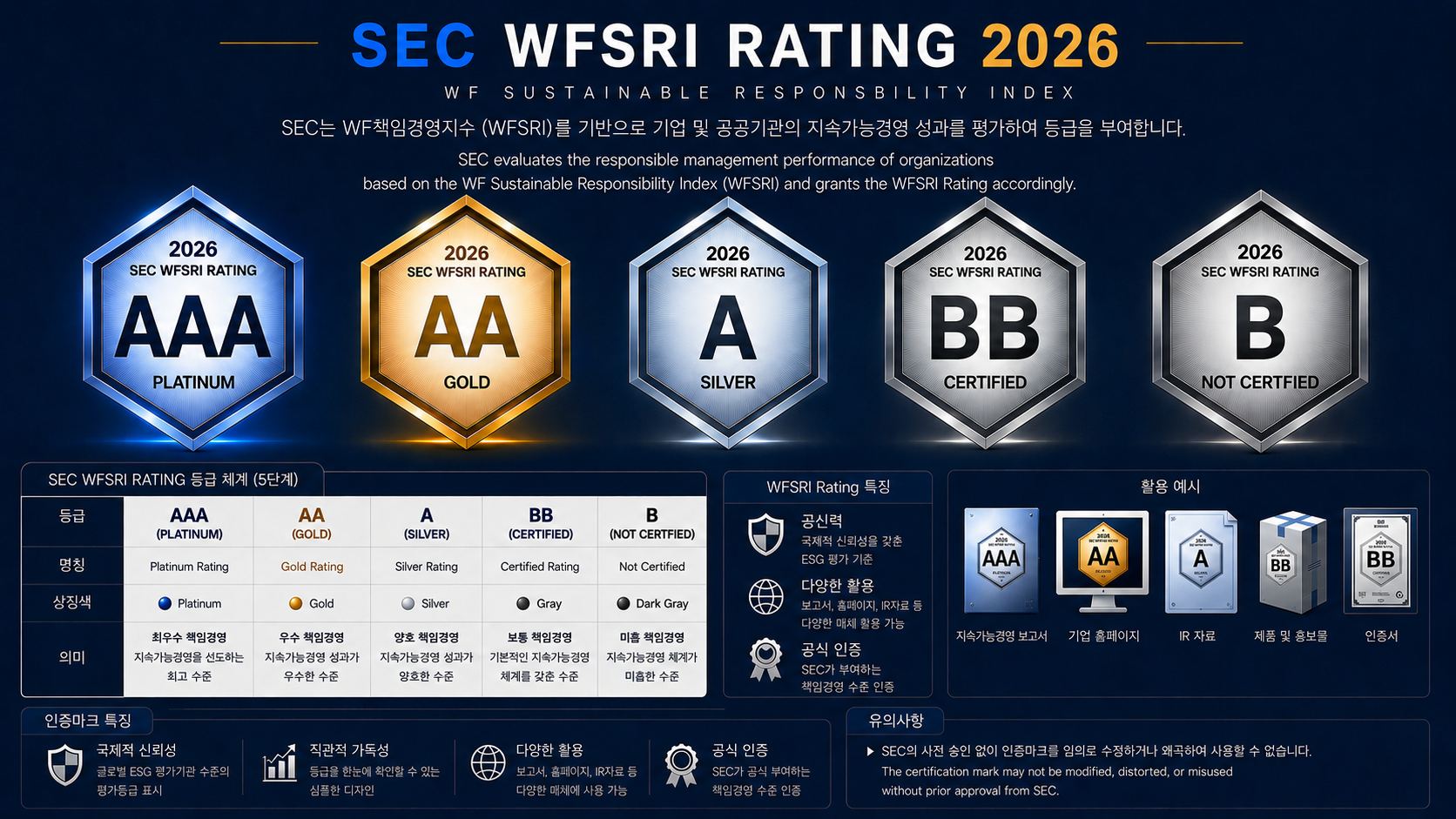
책임경영 등급 (Rating)
책임경영 인증 (Certification)
책임경영 분석 (Analysis)
책임경영 연구 (Research)
정책개발 (Policy Development)
SEC는 평가(Evaluation), 등급(Rating), 인증(Certification), 분석(Analysis), 연구(Research), 정책개발(Policy Development)을 하나의 통합 운영체계로 연계하여 책임경영 문화의 확산과 지속가능한 성장 기반 조성에 기여한다.
SEC integrates Evaluation, Rating, Certification, Analysis, Research, and Policy Development into a unified operational framework, contributing to the advancement of Responsible Management and the foundation for sustainable growth.
핵심 운영원칙
Core Operating Principles
SEC의 모든 평가는 독립성(Independence), 공정성(Fairness), 객관성(Objectivity), 전문성(Professionalism), 투명성(Transparency), 신뢰성(Reliability)을 핵심 원칙으로 수행한다.
All SEC evaluations are conducted in accordance with the core principles of Independence, Fairness, Objectivity, Professionalism, Transparency, and Reliability.
SEC는 공식적으로 공표된 평가원칙과 표준화된 평가방법론을 적용하여 평가의 일관성과 신뢰성을 확보한다.
SEC applies officially established evaluation principles and standardized evaluation methodologies to ensure consistency and reliability throughout the evaluation process.
또한 사실확인(Factual Review), 이의신청(Appeal), 평가윤리(Evaluation Ethics), 이해상충 방지(Conflict of Interest Prevention) 절차를 통해 평가의 객관성과 신뢰성을 지속적으로 강화한다.
SEC further strengthens the objectivity and reliability of its evaluations through Factual Review, Appeal Procedures, Evaluation Ethics, and Conflict of Interest Prevention.
SEC는 평가대상 기관으로부터 평가비·심사비·인증비·후원금 등 평가의 독립성과 공정성에 영향을 미칠 수 있는 어떠한 금전적 지원도 받지 않는 경제적 독립성(Financial Independence)의 원칙을 준수한다.
SEC adheres to the principle of Financial Independence by accepting no evaluation fees, review fees, certification fees, sponsorships, or other financial support from evaluated organizations that could affect the independence or fairness of its evaluations.
미래 비전
Future Vision
SEC는 독자적으로 개발한 WF책임경영지수(WFSRI)를 기반으로 기업·공공기관의 지속가능한 성장과 책임경영 수준 향상에 기여하는 국제적인 책임경영 평가기관으로 발전해 나가고자 한다.
Based on its independently developed WF Sustainable Responsibility Index (WFSRI), SEC seeks to advance as an international Responsible Management evaluation institution that contributes to the sustainable growth of corporations and public institutions and the enhancement of their Responsible Management.
또한 평가(Evaluation), 등급(Rating), 인증(Certification), 분석(Analysis), 연구(Research), 정책개발(Policy Development)이 유기적으로 연계되는 통합 운영체계를 지속적으로 발전시켜 책임경영의 새로운 기준을 제시해 나갈 것이다.
SEC will continue to advance an integrated operational framework in which Evaluation, Rating, Certification, Analysis, Research, and Policy Development are organically connected, thereby contributing to the development of new standards for Responsible Management.
SEC는 앞으로도 책임경영 문화의 확산과 지속가능한 사회 구현에 기여하며 국제사회에서 신뢰받는 독립적인 책임경영 평가기관으로 발전해 나갈 것이다.
SEC will continue to contribute to the advancement of Responsible Management and the realization of a sustainable society while developing as a trusted and independent Responsible Management evaluation institution in the international community.
에스이씨평가원 출범
Launch of SEC Co., Ltd.
SEC의 전문성과 독립성을 강화하고 기업·공공기관 평가업무를 보다 체계적으로 수행하기 위해 기존 법인의 정관을 전부 개정하고 법인명을 주식회사 에스이씨평가원(SEC Co., Ltd.)으로 변경하였다.
To strengthen SEC’s professionalism and independence and to conduct evaluations of corporations and public institutions in a more systematic manner, the Articles of Incorporation of the existing corporation were comprehensively amended, and its corporate name was changed to SEC Co., Ltd.
에스이씨평가원은 SEC의 평가전문성과 독립성을 바탕으로 기업·공공기관을 비롯한 다양한 조직의 책임경영을 체계적으로 평가하고, 객관성과 공정성, 전문성 및 신뢰성을 갖춘 평가체계를 구축·운영해 나갈 예정이다.
SEC Co., Ltd., building on SEC’s evaluation expertise and independence, will systematically evaluate the Responsible Management of corporations, public institutions, and other organizations and establish and operate an evaluation system grounded in objectivity, fairness, professionalism, and reliability.
SEC 평가방법론, SEC 평가체계, WFSRI, 평가 운영규정, 평가결과, 인증제도 및 WFSRI 백서 등 SEC 관련 공식 정보는 에스이씨평가원 홈페이지 구축이 완료된 이후 순차적으로 공개할 예정이다.
Official information related to SEC, including the SEC Evaluation Methodology, SEC Evaluation Framework, WFSRI, evaluation regulations, evaluation results, certification system, and WFSRI White Paper, will be released in stages following the completion of the SEC Co., Ltd. official website.